


Designing AI Voice Agents for 21 CFR Part 11-Ready Life Sciences Workflows
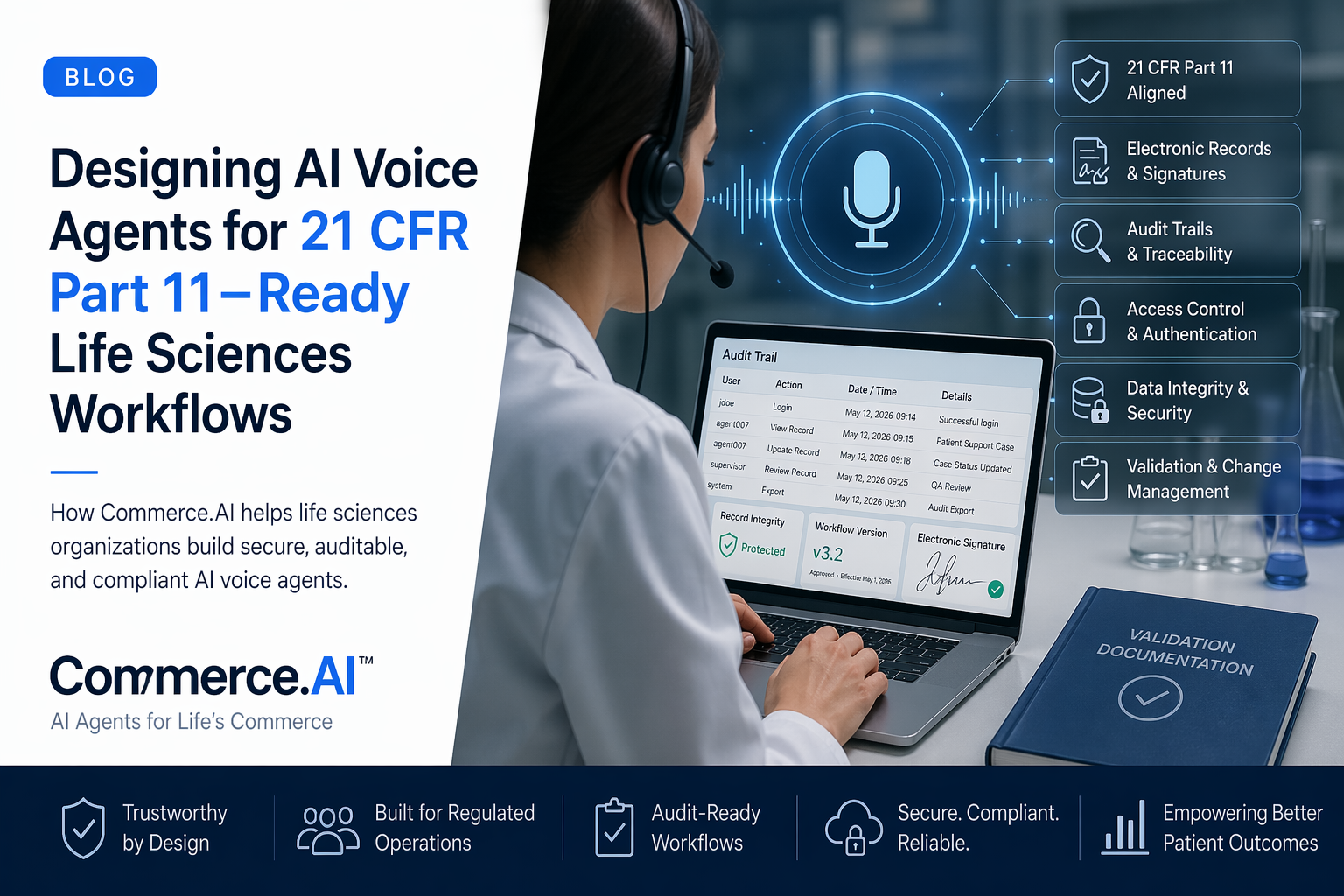
Designing AI Voice Agents for 21 CFR Part 11-Ready Life Sciences Workflows
AI voice agents are rapidly transforming healthcare, pharma, REMS, and patient support operations. As these systems move from simple automation to operational decision-making and data capture, regulatory readiness becomes critical.
One of the most important frameworks in this space is 21 CFR Part 11.
What is 21 CFR Part 11?
21 CFR Part 11 is an FDA regulation that governs the use of electronic records and electronic signatures in regulated industries.
It ensures that:
- Electronic records are trustworthy, reliable, and auditable
- Systems maintain data integrity and traceability
- Access to sensitive data is controlled and monitored
- Actions are attributable to specific users or systems
For AI voice agents, this becomes relevant when the system:
- Collects or updates regulated data (e.g., REMS, patient/provider info)
- Creates audit-relevant records
- Triggers downstream actions in validated systems
Why this matters for AI voice agents
Many organizations underestimate this:
AI voice agents are not just conversational—they can become part of regulated workflows.
Examples:
- REMS missing data collection
- Provider verification and data capture
- Patient onboarding workflows
- Clinical trial coordination
- Case updates in regulated systems
In these cases, the AI is effectively participating in a regulated system-of-record flow.
Core design principles for Part 11-ready AI agents
To support Part 11-aligned environments, AI voice agents must be designed with:
1. Identity and Access Control
- Verified caller identity before sensitive actions
- Role-based access (HCP vs patient vs internal staff)
- Controlled escalation to authorized humans
2. Audit Trails and Traceability
- Timestamped logs of all actions and decisions
- Full transcript capture (with redaction where needed)
- API-level trace IDs for downstream system actions
Commerce.AI systems generate structured logs and audit metadata for every interaction, supporting compliance and review workflows.
3. Data Integrity
- Protection against unauthorized modification
- Controlled data flows into system-of-record APIs
- Validation of inputs before submission
4. Controlled Change Management
- Versioning of prompts, workflows, and integrations
- Approval workflows for production changes
- Rollback capability
Commerce.AI follows formal change management and SDLC processes to prevent unauthorized or unvalidated changes.
5. System Validation Support
- Test scripts and UAT evidence
- Requirements traceability
- Production readiness documentation
Validation is not just technical—it is process + documentation + governance.
Where AI voice agents fit in the architecture
A key principle:
👉 The AI agent is not the system of record
👉 It is the orchestration and interaction layer
Typical architecture:
- AI agent handles conversation, verification, and data collection
- Enterprise APIs (CRM, REMS, EHR) handle record storage
- Audit logs capture the full interaction and decision path
Commerce.AI integrates directly with enterprise systems using secure APIs, ensuring data flows remain controlled and auditable.
Handling PII/PHI in regulated workflows
Part 11 intersects closely with HIPAA and data governance.
Best practices include:
- Identity gating before any sensitive access
- Data minimization (only collect what is needed)
- Real-time and post-call redaction
- Restricted logging and masked transcripts
Commerce.AI enforces strict PII/PHI controls including encryption, RBAC, and redaction across transcripts and analytics.
Common misconceptions
❌ “AI platforms are Part 11 compliant”
No platform is inherently compliant.
👉 Compliance depends on:
- The specific workflow
- The records involved
- The customer’s validation process
- The system boundaries
❌ “Voice bots are just front-end tools”
In regulated environments, they can:
- Trigger transactions
- Capture regulated data
- Influence operational decisions
That makes them part of the compliance scope.
Commerce.AI approach
Commerce.AI designs AI agents for regulated environments from day one:
- Built for healthcare, pharma, and enterprise contact centers
- Supports identity verification and PII/PHI gating
- Provides full auditability and logging
- Enables integration with validated customer systems
- Supports secure deployment (cloud or customer-controlled)
Our platform follows enterprise-grade security and compliance practices, including encryption, RBAC, audit logging, and data protection aligned with regulated industry needs.
Validation is a shared responsibility
Part 11 readiness is achieved through collaboration:
ResponsibilityOwnerWorkflow definitionCustomerSystem configurationCommerce.AIValidation testingJointSOPs and proceduresCustomerAudit readinessJoint
Commerce.AI supports:
- Test design and execution
- Documentation artifacts
- Audit traceability
- Production readiness reviews
Future outlook
As AI adoption grows in life sciences, regulators are increasingly focused on:
- Explainability of AI decisions
- Auditability of automated workflows
- Control over data and system behavior
Organizations that design for compliance early will:
- Deploy faster
- Pass audits more easily
- Scale AI safely across use cases
Conclusion
AI voice agents can absolutely support regulated life sciences workflows—but only when designed with the right controls.
21 CFR Part 11 is not a blocker.
It is a design framework for building trustworthy AI systems.
Commerce.AI helps organizations move fast with AI—while staying compliant, auditable, and production-ready from day one.


