


AI-to-Human Call Transfers

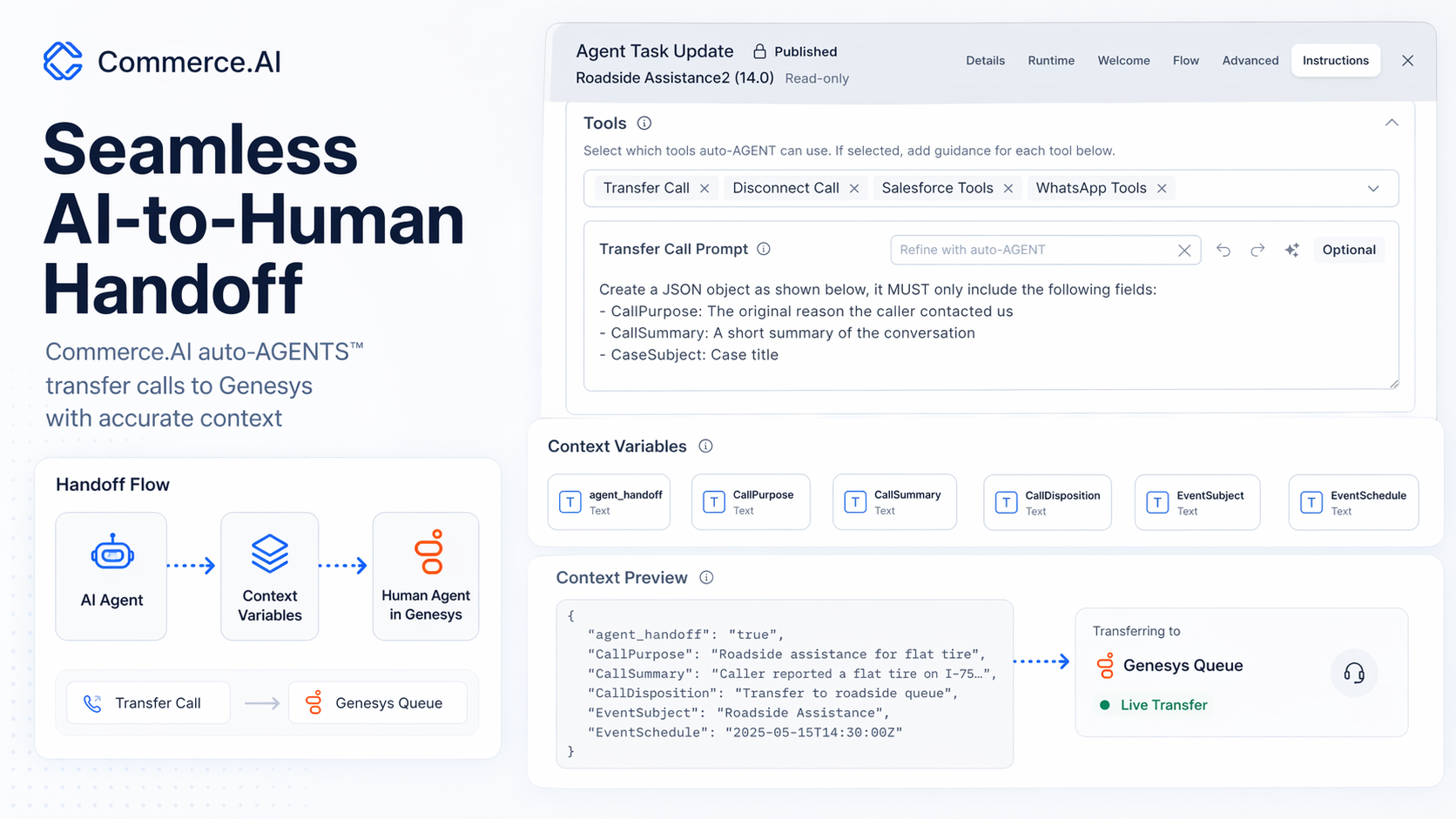
AI voice agents are becoming a powerful front door for enterprise contact centers. They can answer calls, understand intent, authenticate users, collect information, use tools, and complete many routine tasks without waiting for a human agent.
But the real test of a voice AI system is not only what it can resolve on its own.
The real test is what happens when it needs to transfer the call.
In many contact centers, this is where automation breaks down. The caller explains the issue to an AI assistant, the AI collects information, and then the call is transferred to a human agent. But when the agent answers, the customer hears the familiar question:
“How can I help you?”
The customer has to repeat everything.
That is not a seamless handoff. That is a restart.
Commerce.AI auto-AGENTS™ are designed to make AI-to-human transfers feel like a continuation of the same conversation. With integrations into platforms such as Genesys, auto-AGENTS™ can transfer the live call while preserving accurate, structured, and workflow-ready context for the human agent.
Why AI-to-human transfer matters
AI should not trap customers inside automation. A well-designed AI agent should know when it can resolve an issue, when it needs more information, and when the best experience is to bring in a human agent.
That handoff moment is critical.
If the transfer is poor, the caller loses confidence. They may feel that the AI wasted their time. The human agent also loses time because they have to rediscover the issue from the beginning. The business loses operational efficiency because the information collected by the AI is not used effectively.
A good handoff should help the human agent immediately understand:
- Why the caller contacted support
- What the AI already asked
- What the caller already answered
- What systems or tools were already checked
- Why the call is being escalated
- What the human agent should do next
This is especially important in voice conversations because the caller is live. The agent does not have several minutes to read a long transcript. They need concise, accurate context at the moment the call arrives.
The problem with generic transfer summaries
Many AI systems treat handoff context as a simple transcript or a fixed summary.
That is useful, but it is not enough.
A transcript may be too long. A generic summary may miss the fields the business actually needs. A support team may need different handoff information than a sales team. A healthcare workflow may require different context than a travel, banking, insurance, or retail workflow.
A rigid handoff model does not work across enterprise contact centers.
The handoff needs to be flexible.
Flexible handoff variables defined in the bot context
Commerce.AI auto-AGENTS™ can generate flexible handoff variables inside the bot context before transferring the call to a human agent.
These variables are not limited to a fixed schema. They can be defined based on the customer’s workflow, Genesys routing design, CRM process, business rules, or reporting requirements.
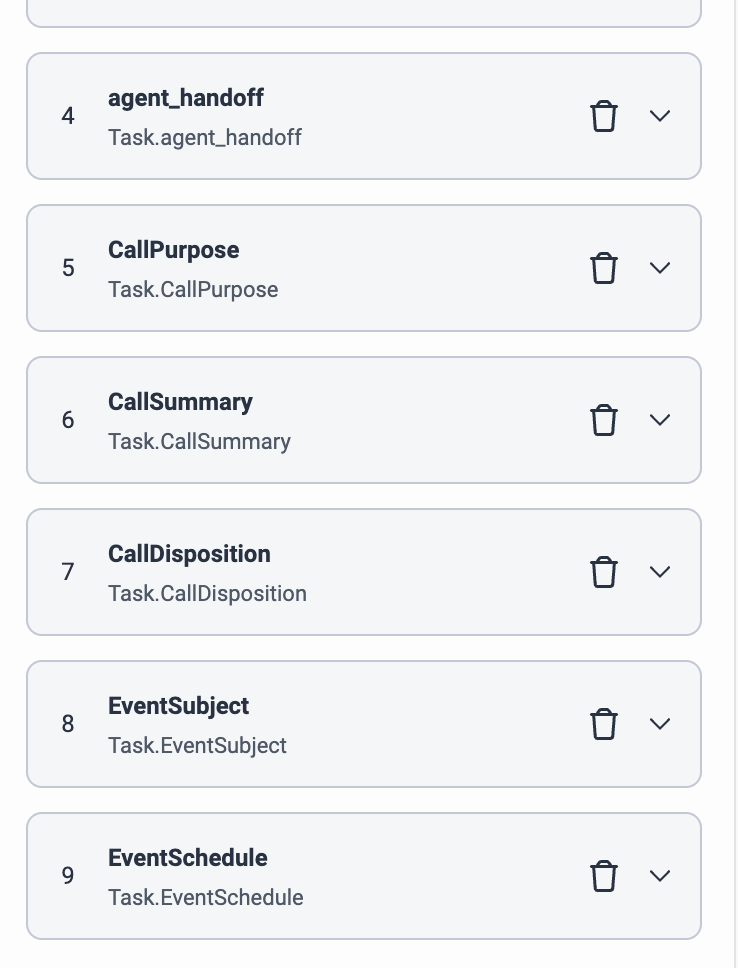
For example, an auto-AGENT™ can be configured to return variables such as:
agent_handoff
CallPurpose
CallSummary
CallDisposition
EventSubject
EventSchedule
These are examples only. The fields are completely flexible and can be defined in the bot context.
A healthcare support workflow may define variables for member intent, eligibility issue, escalation reason, and case subject. A sales workflow may define lead qualification, product interest, preferred callback time, and recommended sales queue. A service workflow may define service request type, appointment preference, disposition, and next action.
This flexibility allows Commerce.AI auto-AGENTS™ to create context that is not just readable by a human, but usable by the downstream contact center workflow.
Example: Genesys call transfer with context
In a Genesys contact center, a Commerce.AI auto-AGENT™ can answer the call, conduct the conversation, use configured tools, and then transfer the call to the right human queue when needed.
A typical flow looks like this:
- A customer calls into the Genesys contact center.
- Genesys routes the call to a Commerce.AI auto-AGENT™.
- The auto-AGENT™ greets the caller and understands the reason for the call.
- The AI collects required information and attempts to resolve the issue.
- If escalation is required, the AI populates configured task variables in the bot context.
- The live call is transferred to the appropriate Genesys queue or human agent.
- The human agent receives the call with accurate context instead of starting from zero.
For example, before transferring a call, the auto-AGENT™ may prepare context like this:
{
  "agent_handoff": true,
  "CallPurpose": "Caller wants to reschedule an existing appointment",
  "CallSummary": "The caller confirmed their name and phone number. The AI checked the appointment details and determined that the requested change requires a human agent because available time slots are limited.",
  "CallDisposition": "Needs human follow-up",
  "EventSubject": "Appointment rescheduling request",
  "EventSchedule": "Caller prefers tomorrow afternoon"
}
When the human agent receives the call, they are not guessing. They can begin with:
“I see you were calling about rescheduling your appointment. I have the details here — let me help you with the next available time.”
That creates a very different experience for the customer.
Why flexible variables are better than one fixed handoff format
Every enterprise contact center is different.
One customer may want a short call summary. Another may want a case subject, disposition, and escalation reason. Another may want CRM fields. Another may want appointment details. Another may want routing hints for Genesys queues.
Commerce.AI auto-AGENTS™ support that variety by allowing handoff variables to be defined in the bot context.
This means the handoff can be adapted for:
- Genesys queue routing
- CRM case creation
- Agent screen-pop context
- Post-call analytics
- Quality assurance
- Compliance review
- Appointment scheduling
- Sales qualification
- Service request workflows
- Human escalation workflows
The same auto-AGENT™ platform can support different industries and workflows without forcing every customer into the same transfer model.
What the human agent should receive
The best human handoff is concise, structured, and immediately useful.
The agent should not have to read an entire transcript while the caller waits. The agent should receive the essential context needed to continue the conversation.
That may include:
{
  "CallPurpose": "Caller needs help updating delivery information",
  "CallSummary": "The caller wanted to change the delivery address for an existing order. The AI verified the caller’s phone number and located the order, but the address change requires human approval because the item has already shipped.",
  "CallDisposition": "Escalated to human agent",
  "EventSubject": "Delivery address change request",
  "RecommendedNextStep": "Confirm the updated address and check whether the carrier can reroute the package"
}
In this example, the agent can immediately understand the caller’s intent, what the AI already completed, and why human support is required.
The customer does not need to repeat the same story.
Better routing with better context
Structured context is useful not only for the human agent. It can also improve routing.
Before transfer, the auto-AGENT™ can identify the reason for escalation and help route the call to the right place.
For example:
- Billing issue → billing queue
- Technical issue → support queue
- Policy question → specialist queue
- Sales-ready caller → sales queue
- Frustrated caller → priority escalation
- Appointment change → scheduling team
- Complex service request → human agent with proper permissions
In Genesys, this allows the contact center to move beyond simple transfer logic. The AI can help determine the right destination based on the actual conversation, not just the phone number dialed or menu option selected.
That makes the transfer more intelligent and reduces unnecessary re-routing.
Tool-aware handoffs
Another advantage of Commerce.AI auto-AGENTS™ is that the handoff can include what happened before escalation.
If the AI used tools during the call, the handoff can summarize those tool results.
For example:
- The AI looked up an order and found it was already shipped.
- The AI checked appointment availability and found no matching slot.
- The AI verified the customer’s identity.
- The AI attempted a CRM lookup but the record was missing.
- The AI collected required information but policy required human approval.
- The AI detected that the caller explicitly requested an agent.
This gives the human agent a clear starting point.
The agent does not have to repeat steps the AI already completed. They can focus on the unresolved part of the interaction.
A better customer experience
From the customer’s perspective, seamless handoff means one simple thing:
They do not have to start over.
They can speak naturally to the AI, get help, and if needed, continue with a human agent who already understands the issue.
A strong AI-to-human transfer sounds like this:
“I have the context from our assistant. You were calling about your appointment change, and it looks like we need to confirm a new time manually. I can help with that.”
That small difference matters.
It shows the customer that the automation was useful. It shows that the company is coordinated. It shows that the human agent is informed and ready.
Operational benefits for the contact center
Seamless AI-to-human handoff can improve both customer experience and operational performance.
It can help reduce average handle time because the agent begins with context. It can improve first-call resolution because the agent understands the previous steps. It can reduce customer frustration because callers do not have to repeat themselves. It can improve quality assurance because escalation reasons and call summaries are captured consistently.
It also creates better analytics.
When handoff variables such as CallPurpose, CallDisposition, EventSubject, or escalation reason are captured consistently, contact center leaders can understand why calls are being transferred and where automation can be improved.
For example, teams can analyze:
- Which intents are most often escalated
- Which queues receive the most AI transfers
- Which tasks require better tools or integrations
- Which workflows need policy changes
- Which call types can be automated further
- Which human-agent queues need better context
This turns handoff from a black box into a measurable workflow.
Human agents remain essential
The goal of AI in the contact center is not to remove humans from every interaction.
Some conversations require judgment. Some require empathy. Some require approval. Some require exception handling. Some require a licensed, trained, or specialized agent.
auto-AGENTS™ are designed to handle the work they can complete and transfer the work that should be handled by humans.
The key is making that transfer intelligent.
A human agent should not have to rescue a broken automation experience. They should be able to continue a well-documented conversation with the right context already prepared.
Conclusion
The future of enterprise contact centers is not AI-only. It is AI and human agents working together in a coordinated workflow.
Commerce.AI auto-AGENTS™ make that coordination practical.
With Genesys integration, flexible bot-context variables, tool-aware summaries, and structured handoff data, auto-AGENTS™ can transfer live calls to human agents without losing the conversation thread.
The result is a better experience for the caller, a faster start for the human agent, and a more measurable workflow for the contact center.
A seamless transfer is not just moving a call from AI to human.
It is moving the conversation forward.


